How to Read Nutrition Headlines Like a Scientist


How to Read Nutrition Headlines Critically – Navigate the Information Ocean Safely
Original study: Association of eating duration less than 8 h with all-cause, cardiovascular, and cancer mortality
Media article based on this study: Divány Article
Every day, we see sensational health headlines like “This diet will kill you!” or “Eat like this and live longer!” These headlines can trigger fear or hope but rarely show the full picture. Learning how to read scientific studies critically allows you to safely navigate the sea of information and make better decisions about your health.
This article aims to help you interpret such statements calmly and sensibly, using critical judgment.
Important note about intent
This article is not intended to discredit Dívány or any other media outlet. The article cited as an example illustrates a broader phenomenon: how scientific findings can become simplified or misrepresented in the media.
Newspaper articles are written by people with different backgrounds and intentions, and Dívány also publishes many balanced, informative articles.
The goal is not to blame, but to show how you, as a reader, can become better prepared so that the information you rely on will truly be useful to you.
Step 1 – Know the Study Type
There are two main types of studies you’ll see in health research:
Randomized Controlled Trials (RCTs):
- Participants are randomly assigned to groups, for example, one group following a new diet and another group following usual habits.
- This randomization reduces bias and helps researchers see whether the intervention causes the effect.
- Example: An RCT could test if limiting eating to 8 hours per day actually improves blood sugar control.
Observational Studies:
- Researchers watch what people already do, without assigning any interventions.
- Example: Looking at people who naturally eat in an 8-hour window and seeing how their health compares to those who don’t.
- Observational studies can find associations but cannot prove cause and effect because other factors may explain the results.
Step 2 – Watch for Confounding Factors
Sometimes, results can be influenced by other variables, called confounding factors. These are things that make it hard to know whether the outcome is really caused by what you’re studying.
- In the study on eating duration <8 h, participants were more likely to be younger, men, smokers, or from groups with food insecurity.
- Even after statistical adjustments, these differences could affect results.
- Think of it like noticing that people who carry umbrellas often get wet – it doesn’t mean the umbrella causes rain!
Step 3 – Check Study Limitations
- The study relied on two 24-hour dietary recalls, which may not perfectly represent what people usually eat.
- Important factors like sleep, stress, or physical activity were not fully accounted for.
- Mortality and heart disease depend on many things, not just eating duration.
Step 4 – Compare with Other Evidence
- Short-term RCTs show that time-restricted eating can help with weight and blood sugar.
- No long-term RCTs exist yet showing mortality effects.
- Observational studies can show patterns, but don’t prove harm or benefit on their own.
Step 5 – Be Skeptical of Headlines
Media articles often exaggerate findings. Check whether the conclusion really matches the study data. Headlines like “This diet increases your risk of death” may ignore the fact that other factors could explain the results.
Step 6 – Ask About Causation vs. Correlation
- Correlation: Two things happen together, but one does not necessarily cause the other.
- Causation: One thing actually produces the other.
Example: Eating <8 hours was linked to higher cardiovascular mortality in the study. That does not mean short eating windows caused it – other factors may explain the link.
Step 7 – Use Tools and Resources Wisely
- Check the study type, sample size, and follow-up time.
- Look beyond the headline.
- Identify confounding factors and study limitations.
- Compare results with other studies.
- Ask if causation is proven.
- Verify the original source.
💡 Pro Tip: You can even use ChatGPT as a study analysis tool. Paste parts of a study and ask questions like:
- “What type of study is this?”
- “What possible confounding factors exist?”
- “Do the conclusions match the data?”
It can guide your thinking but does not replace your own critical evaluation.
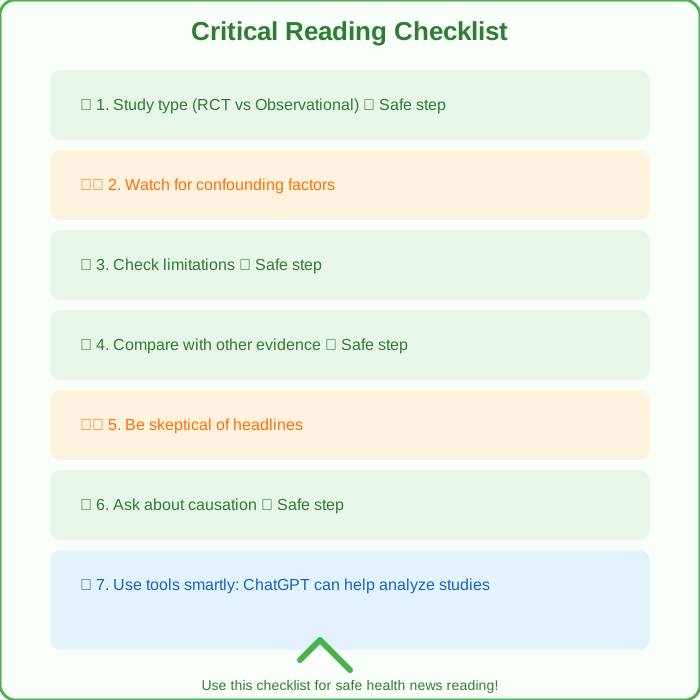
Quick Visual Checklist
Key Takeaways
- No single study is the final answer.
- Observational studies show patterns, not cause-and-effect.
- RCTs are the gold standard, but they are expensive and time-consuming, and therefore rarer.
- Learning to read studies critically helps you avoid unnecessary fear and make informed health decisions.
Closing thoughts
This article is not about a single author or medium, but about how we consume information.
Communicating scientific results is a complex task, and even with good intentions, it can easily be misunderstood.
Critical thinking is not an attack on others – it is a defense of ourselves.
Disclaimer: This content is for educational purposes only and does not replace professional medical, legal, or other advice. All interpretations of scientific studies or media reports are based on publicly available information and aim to promote critical thinking. This blog may summarize or comment on studies and media reports but is not responsible for the content of original sources. Always consult qualified professionals before making changes to your diet, lifestyle, or health practices.